Friday, August 03, 2007

a m.m.! 8 things about m.

I've been tagged by the eloquent Laurelin for the 8 random things about me meme. So here goes again:

1. i'm emotionally quite impassive a person. i have to sometimes remind myself to show a reaction.

2. i tend to catch myself making the fundamental assumption that if i know it, of course you do. or you should - even i know it!

3. there's no such thing as eating too many vegetables. however, copious amounts of raw green leafy stuff makes me mean and desperate! i hate lettuce.

4. i have a mole on one of my soles that keeps disappearing and reappearing.

5. i love the osho tarot pack (about the only thing i like about osho!) because the cards are beautifully designed. i can vouch for at least the air suite being uncannily accurate. i think someone did some fanstastic people watching when they designed that pack!

6. i am developing road rage. i feel very frustrated that i don't know enough swear words in tamil. the stint in south africa totally cleared up my language - i didn't have to drive, so i didn't swear. simple.

7. i think i have briefly bitterly hated almost all the people i love the most.

8. i believe it is perfectly fine - even good - to judge, to discriminate. the only clause attached, is that you should do a good job of it, and follow the profession's ethics!

let's see. i tag these people: senthil who hasn't written in a long time. neither has sriharsha, so i'll tag him too. the happy feminist appeared briefly and vanished again, so here's tagging her as well!

Labels:

Friday, December 29, 2006

5 things you didn't know about me

the yearly quota of two tags is about to be completed. evidently ive been tagged by vivek, whom i do not know - and who, i imagine, cannot possibly know me personally if he's a techie! :D

in case you experienced a burning desire to know 5 inane things about me, 'ere you go:

1. i love bitter chocolate. it gives me shudders of delight. almost nothing in the world can depress me to the extent that bitter cant reach and pull me out of. i also think milk chocolate is ee-yew and should be outlawed!

2. my face often betrays what im thinking or how im feeling - it used to get me into heaps of trouble in college! whenever a prof talked nonsense in class, ole reliable would promptly assume an "eeks! what garbage are you talking?!" expression, making it necessary for me to drop my pencil and duck out of sight until i could freeze it into plastic indifference.

3. in my management classes (and even generally i guess) i tend to think like an employer. i have very limited sympathy for trade unions and communist outrage against wealth. my commerce teacher used to give me a sardonic smile every time i was conspicuously silent when the class broke into heated pro-labour discussions.

4. there are some odd jobs around the house that i really love doing - ironing with a steam iron, cooking, and washing dishes. they all give me a sense of peace and the feeling that all my troubles will be sorted out. i like embroidery too. when im embroidering i can switch off to the world and spend hours chewing over some topic peacefully or just being oblivious to the world. (that is how i spent most of today.)

5. i get hassled by ugly noises and colours. i feel uneasy if my bedsheets or pillowcases are wildly mismatched or in jarring colours. if my phone rings more than 4/5 times in half an hour, i generally switch it off and, if possible, push off for a quiet walk.

Labels:

Wednesday, November 08, 2006

tagged for feminism

aishwarya had tagged all contributors on sthreeling for the feminism tag ("5 things feminism has done for you"). sorry for the delay a., here it is at last:

1. feminism has made me a happier person in a lot of ways, and added to my sense of self worth. there are days when, even if my whole world has fallen apart and nothing's going right, i still think "i'm a woman", and feel this absolute rush of joy!

2. i love the emphasis that feminism places on honesty and ethics in analysis. one of the things that bothers me about mainstream academic/scientific thought is that it seems to be conducted in ethical and moral vacuums.
as noam chomsky once remarked, "the intellectual tradition is one of servility to power, and if i didn't betray it i'd be ashamed of myself."

3. i think i've become more responsible and more socially aware a person. there are so many things that i did not perceive before - so many worlds i didnt know coexisted with mine. after my introduction to feminism, i've also become more aware of silence being as political a gesture as active dissent or assent. i've learnt that brute force (or power) is different from strength.

4. feminism has taught me a lot about myself. my first encounter with feminist writing reassured me that i wasn't insane, and that amongst other things, it was in fact normal to be bothered by violence and misogyny. ironically that first book also shook me up and churned my mind. it took a while to be able to accept the things i was reading - and not feel like a criminal!

5. feminism has been mind and soul food, and so intellectually a very deeply satisfying experience! it has helped me clear up my head and be surer about what is important to me, how much freedom and responsibility i can handle comfortably, the codes i live by, my tread-carefully-here mental landscapes ... assorted things like that. one of the things i like immensely about feminist theory is that it doesnt "talk down" to the reader.
and its very interesting and leads somewhere- unlike the writing of kant, russell, aristotle or rand. (general public to pliss ignore the last sentence : its a very specifically directed dig at Some People. har har har!)


also posted on sthreeling.
. . .

psssst. if you still haven't noticed - look to the right. a proper index. and all.

*beaming*

themes

Labels:

Monday, January 09, 2006

yoni worship

The Series:

feminism in indian culture
the origins of a tradition
shakthi worship and philosophy
yoni worship

* * *
in a culture of such reverence for the feminine, you bet you can find at least a small cult to salute the yoni!

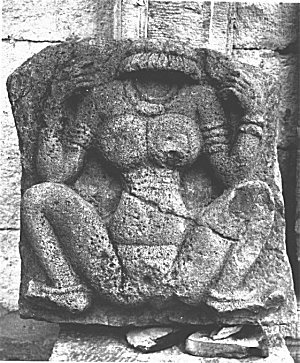
the yoni yantra, basically a triangle, represents the mother goddess, and indicates the cosmic womb, and hence the source of life. the yoni is considered the doorway to understanding the mysteries of the universe. in ritualism, this gets represented as sculptures of the goddess lying with her legs spread, or standing with her feet apart so that worshippers may stand at the yonic entrance and symbolically drink the yoni tattva (her menstrual blood) to assimilate it as the sublime essence of the world.

the goddess with her yoni shown for worship, and a lotus budding from her neck to signify creation

the yoni tantra divides the yoni into 10 parts, each of which is considered a manifestation of the divine feminine (devi). also, (interestingly!) in shaktha philosophy, menstrual blood is considered sacred, and menstruating women are revered. during her periods, a woman's body consciousness being keener, she experiences a drawing in of energy and feelings to a deeper level of consciousness. it is believed that during her periods, the different rhythms that set in in her body are more closely related to those of nature. since the body is considered a microcosm of the universe, understanding and praying to the feminine is a way of understanding and revering the divine.

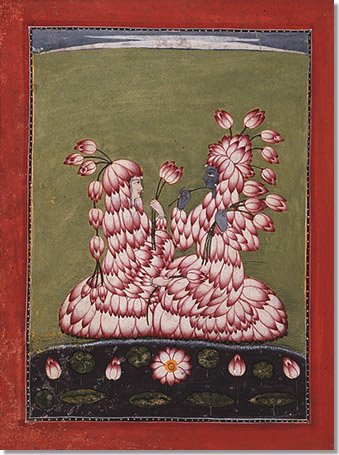
the yoni is often compared to a lotus. just as the flower remains pristine despite the water and mosses surrounding it, the yoni is believed to be pure, no matter how many times it menstruates or engages in intercourse. also, as water represents consciousness, and the flower (yoni) is rooted in consciousness, it is said to support all life and creation. while this is a slightly off-beat view, popular religion also depicts several gods and goddesses as being seated on lotuses.

radha and krishna seated on a lotus

* * *


what ive written of the tantric and shaktha schools is the bare essentials of their philosophy. imho, they started out with a good concept but later got carried away, so im sticking to what appeals and makes sense to me!

also since i dont want to get into religion proper, fascinating as they are, im skipping the kali and durga female archetypes and the fantastic tales about them (with much regret!). but please do read that mookerjee book - 'tis the nicest ive come across so far on this subject... especially if youre a woman, gosh, its awesome reading! :D

Labels:

shakthi worship & philosophy

The Series:

feminism in indian culture
the origins of a tradition
shakthi worship and philosophy
yoni worship


* * *
the sanskrit word shakthi means force, the feminine energy. it is regarded as the primordial creative principle that underlies the cosmos, and as the energising force behind all divinity, creatures and beings.

in several scriptures, the personification of shakthi - kali - was said to be the source of the three aspects in divinity,ie creation, protection and transformation. (for example the niravana tantra narrates how brahma, vishnu and shiva were all born of kali; in the kamanda tantra kali is considered to be brahman personified.)

the ritualistic aspects of shaktha philosophy is marked by the pantheon of female deities, each created to worship a different aspect of feminine power. the breasts, bellies, and yonic* entrances of the goddesses are worshipped and touched reverentially as symbols of the source of all life and the focus of cosmic energy. several vessels are used in worship, signifying the shaping of life, and rebirth. the vessels are also a symbol for the idea that the human body is as a vessel for spiritual transformation.

ritual vessel shaped like a yoni

mainstream hinduism retains traces of shaktha philosophy and rituals as well. even now, the main chambers of temples are built as wombs (garba graha - the womb chamber), the overall structure signifying the yonic passage. (emerging from the chamber thus denotes the "reborn" person.) and all our gods and goddesses have bodies which emphasise their feminine nature - wide hips and thighs and so on.


shiva as natraja with feminine thighs and hips

* yoni - (sanskrit) vagina

Labels:

the origins of a tradition

The Series:

feminism in indian culture
the origins of a tradition
shakthi worship and philosophy
yoni worship

* * *

feminism is usually associated with the movement that started in the west (especially in america). however, all of the old cultures in the world have feminist orientations in that they have all (at least in the beginning) worshipped mother goddesses and celebrated the feminine as divine. patriarchy eventually distorted the cultures and traditions, but nonetheless, these roots do exist. indian culture has a whole school of thought that traces back to a couple of centuries BC. *three cheers for nice ancestors! :D*

pre vedic religion was female - oriented. Aditi was the main goddess, who personified the great womb in which the whole universe was said to be contained. she holds agni in her womb as a mother contains a foetus. the feminine, being regarded as the wellspring of life, almost all the primary gods of the vedic pantheon were born of Aditi.

the vedic period seems to have marked a distinct shift to patriarchy. prithvi and surya, initially goddesses, were cast as male gods in vedic times. several of the goddesses were relegated to the background. however they made a reappearance in post vedic literature and regained their primacy in classical and medieval hinduism. puranic literature gives various names to the universal feminine power. these, and the hundreds of treatises written since 200 AD form the structural body of the philosophy and traditions of shakthi worship. hardly any of these earlier works have survived, but they are discussed in several philosophical and religious works of the shaktha system from post buddhic times to 1200 AD. this knowledge is also the basis of the tantric thought.

medieval hinduism considered women to be feminine divinity manifest. the female consorts of gods were considered the source of the gods' powers, and were often regarded as being more powerful. in several songs, epics and poems, the gods (shiva downwards) voice their inability to manifest or create without the consorts, who however, can exist and manifest without them.

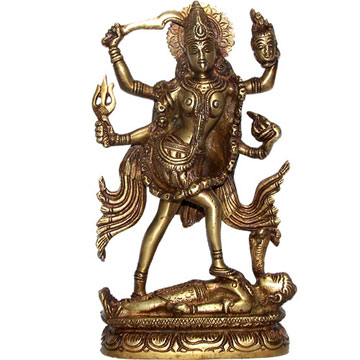
kali dances on a prostrate shiva

(nb: i was thoroughly muddled at first, but this is how it seems to work - the shakthi here, is different from shiva's consort. the nature of the sum of the cosmic force is considered feminine, and this is called shakthi. she thus contains prakrithi and purush.)

in tantrik and shaktha doctrines, the feminine power continues to be held supreme. archetypal women are celebrated in different goddesses, and womanhood is the essence that raises the human being to semi divine status, freeing the mortal from the bonds of stereotypes of beauty and docility.

yashodha suckling krishna.
(far from being taboo, breasts were revered - goddesses were bare breasted,
depicted only with jewellery for adornment)

shaktha philosophy also includes male shakthas (worshippers). for them, the worship activates the feminine qualities in the male. there is sometimes even a ritual tranvestism practised (literally unman-ing), so that the male destructive ego may be shed to allow the feminine to be assumed. vaishnavism still follows this quite strictly. even in the mainstream hinduism we see today, the equal activation and harmonious fusion of male and female qualities is emphasised, using gods like ardhnarishwar.

Labels:

feminism in indian culture.

The Series:

feminism in indian culture
the origins of a tradition
shakthi worship and philosophy
yoni worship

* * *

i happened to read some interesting snippets about the yonic tradition, and was ab-so-lootly riveted. on further digging around, i found :

1). any real literature on the subject is nearly impossible to find.... how much i had to search! *pant pant*

2). one very nice book - an absolute treasure - on shakthi worship. *yahoo!*

it goes under the deceptively meek name of "kali, the feminine force" and is quite a kick in the pants. highly recommended buy. author, ajit mookerjee. so what follows is basically from this book, with afore mentioned snippet reading, and much grandmother- and other-people-grilling! :d

this is a highly ambitious undertaking i know, but i still have to try! im not going into the interesting depths of the philosophies or symbols, but am sort of merely planting markers to say "oh look, here's this neat thing"..... (and maybe also "whee! isnt this exciting?!" hehe...).

and so, the next three posts are little potlums of feminism in our culture :D

Labels: ,

Monday, September 19, 2005

an epitaph

thanks senthil. the tag gave me a chance to say this - and i really needed to! :)

An Epitaph

They always fought when she was alive. She was a tyrant. We hoped he would enjoy his new freedom. Sadly, he was just too lost without her. after he died, we found her death certificate and an old sepia photo of them together under his pillow.

His was love that had quietly weathered 65 years.

Labels: ,

Monday, August 01, 2005

and so it goes.

You’d have noticed a most critical work is missing in this write up. Mary Wollstonecraft’s “A Vindication of the Rights of Women” written in ……1792! The reason is that im still awed by the feat. The sheer progressiveness of such a book, the kind of resistance the author would have to deal with from the moment of conception of such a work is mind boggling. Hers was the first feminist work – she buried the seed for the movement which was to sprout and grow only a 135 years later. If youre a woman and you're literate: please - write write write!

I have left out huge chunks of this fantastic book (S/T P), because as I said earlier, I was overwhelmed by the scope of information it gave! I do hope you can get your hands on this book to read it some time (not to mention all the other wonderful writing on which this is based).

so that concludes the dash through feminist literature. i gather you folks werent wildly excited readin it, but i must say i was grinning happily whenever i was writing it! talk about awesome ideas for a life time... have a nice weekend all :)


Sexual/Textual Politics

Sexual/Textual Politics - the beginning of feminist writing

Kate Millett - Sexual Politics

Katherine M Roger, Mary Ellman

Images of women

And so it goes

Labels:

images of women

And so, on to images of women! This is a branch of feminist criticism. It all started with a collection of essays called “Images of Women in Fiction: A Feminist Perspective”, edited by Susan Koppelman Cornillon.

In her introduction to the book explaining the need for such a book, Cornillon says “… books that would study literature as being writings about people. … These essays lead us into fiction and them back out again into reality, into ourselves and our own lives. This book will be a useful tool for raising consciousness…”

Feminist literary studies link literature to life, particularly to the lived experience of the reader. These women introduced a feminist contention that no criticism is “value-free”. All we speak, is from a specific position shaped by cultural, social, political and personal factors. It is authoritarian and manipulative to present this limited perspective as “universal”. That remains one of the fundamental assumptions of any feminist critic to date.

Toril Moi goes on to deal with women’s writing and writing about women in depth. In the late 1970s, there were 3 major studies on women writers, which are seen as part of a specifically female literary tradition or “sub-culture”.

The studies are:

  1. Ellen Moers – “Literary Women” (1976)
  2. Elaine Showalter – “A Literature of Their Own” (1977)
  3. Sandra Gilbert and Susan Gubar – “The Madwoman in the Attic” (1979).

These 3 works represented the coming of age of Anglo American feminist criticism. Moi says of them “For these critics, it is in other words society, not biology, that shapes women’s different literary perception of the world”.

Of the three, I think (I cannot recall with certainty) it was Showalter’s work that was especially significant to feminist literary criticism. She explains women’s literature’s stages as:

“First there is a prolonged phase of irritation of the prevailing modes of the dominant tradition, and internalisation of its standards of art and its views on social roles. Second, there is a phase of protest against these standards and values, and advocacy of minority rights and values, including a demand for autonomy. Finally, there is a phase of self-discovery, a turning inward freed from some of the dependency of opposition, a search for identity. An appropriate terminology for women writers is to call these stages, “Feminine”, “Feminist”, and “Female”

The Feminine period was when male pseudonyms were used – from the 1840s, until George Eliot died in 1880. The Feminist period is from 1880 to 1920, and from thereon, the Female period started. In the 1960s there was a new dimension to women’s literature as it became more significant to the women’s movement. This period continues now.

In “The Madwoman in the Attic”, Gilbert and Gubar spoke of the sudden spate of literature wherein there was a woman who was mad. They declare “To be selfless is not only to be noble, it is to be dead.” (hear hear!). To be able to express themselves and voice their thoughts honestly, the authors had to create a “mad” woman since society wouldn’t countenance such thoughts being those of perfectly sane, intelligent women.

The “mad double” is a common factor in all the 19th century novels studied in this work. The madwoman, like Bertha Mason (Jane Eyre by Bronte) is

“Usually in some sense the author’s double, an image of her anxiety and rage. Indeed, much of the poetry and the fiction written by women conjures up this mad creature so that female authors can come to terms with their own uniquely female feelings of fragmentation, their own sense of the discrepancies between what they are and what they are supposed to be”.

Mary Jacobus criticised Gilbert and Gubar saying that their recognition of only anger as a positive signal of feminist consciousness was also reductionist.


Sexual/Textual Politics

Sexual/Textual Politics - the beginning of feminist writing

Kate Millett - Sexual Politics

Katherine M Roger, Mary Ellman

Images of women

And so it goes

Labels:

Katherine M Roger, Mary Ellmann

Katherine M Roger’s work was much less talked about, though it was equally important. She explored the history of sexism in literature. She explained the cultural reasons for misogyny as being–

a rejection of or guilt about sex

a reaction against the idealisation with which men have glorified women (eg. as mothers)

patriarchal feeling: the wish to keep women subject to men.

Mary Ellmann’s work “Thinking About Women” followed in 1968. She said “I am interested in women as words.”

Her work was the basic source for the “images of women” criticism (which is brilliant!). She spoke of how Western culture at all levels is permeated by sexual analogy. She said that there is a “tendency to classify all experience by means of sexual analogy”. Ordinarily, not only sexual terms, but also sexual opinions are imposed upon the external world. She drew the 11 major stereotypes of femininity as presented by male writers and critics. (since I can’t resist giving you a sneak preview of that here it is! – formlessness, passivity, instability, confinement, piety, materiality, spirituality, irrationality, compliancy, the Witch, the Shrew)

In Sexual Politics, there’s a nice illustration of how we accord male voices more importance than female voices. Pil Dahlerup was writing about a critic reviewing Cecil Bodker’s poetry, and he used words like “charming” and “sweet” for women’s poetry, and “serious” and “significant” for men’s. (ouch)


Sexual/Textual Politics

Sexual/Textual Politics - the beginning of feminist writing

Kate Millett - Sexual Politics

Katherine M Roger, Mary Ellman

Images of women

And so it goes

Labels:

Kate Millett - Sexual Politics

Moving to 1969 and Kate Millett’s book.

Millett was the first to define and bring focus to the term “sexual politics”. Her work is seen in three parts: sexual politics, its historical background, and the literary reflection of such politics.

Millett’s book paved the way for the 70s’ feminism. She opposed the prevailing critics, and insisted that social and cultural contexts must be studied if literature were to be properly understood. The critics up to then had maintained that the Author was the Authority. (aren’t those two words interesting! their roots are nicely twined) Until Millett’s bold assertion, the author was not questioned or even disagreed with! Doesn’t that really make you sit up and gawp?! The liberty, which we so automatically claim now, was actually only that recently granted.

According to Millett, this conflict between the reader and the author exposes the premises of the author’s work. The prevailing image of the reader until then was of being primarily passive/feminine, since the reader was basically the unquestioning recipient of authoritarian discourse.

She says sexual dominion is the most pervasive ideology of our culture and provides its most fundamental concepts of power. She asserts “The essence of politics is power”. The ruling sex maintains and extends its power over subordinate sex. This process is pervasive throughout cultural life.

She also speaks about love, saying “Both the courtly and the romantic versions of love are “grants”, which the male concedes out of his total power. Both have had the effect of obscuring the patriarchal character of Western culture and in their general tendency to attribute impossible virtues to women, have ended up by confirming them in a narrow and often conscribing sphere of behaviour.”

Millett’s work was certainly a significant milestone in feminist literature, and did much to bridge the gap between the academic struggle and the actual fight in the trenches for women’s rights, but her work was also criticised on several counts.

Later feminists like Juliet Mitchell and Jacqueline Rose supported the Freudian theory, saying that sexual identity is not an in-born, biological essence. Freud’s psychoanalysis sees sexual identity as being culturally and socially constructed. (Does that remind you of Ru Paul? “We are all born naked. The rest is just drag”!)

Millett had rejected this premise completely, and ignored the fundamental Freudian insight that unconscious desire has an influence on conscious action.

Some of the important issues raised by Kate Millett and discussed by several later feminists were:

  1. her assumption that women merely have to see through the false ideology of the ruling patriarchy in order to cast it off and be free. She didn’t realise that women may internalise the standards of the oppressors, and may identify gradually with their own persecuters. (this is why it’s so confusing and difficult even now to decondition ourselves: we even think like our oppressors in so many things)
  1. she expected feminism to be fully conscious, morally and politically correct – it must know what it wanted. Feminism was however, a fledgling movement. What women wanted was full of contradictions and confusion, and entangled with what patriarchy wanted them to be or wanted for them.
  1. She pointed out male sexual violence against women as displayed in modern literature, and the male degradation of female sexuality. This was something that everyone agreed on.
  1. Millett rejected the romantic discourse in “Villette” (by Bronte) as being a purely conventional device. Later feminist critics (like Mary Jacobus) question such a stern rejection saying that only that allows for some scope in increasing sexuality and femininity of characters.
  1. In upsetting the author-text-reader hierarchy, Millett only recognised the male author! That left a huge unexplored issue as to how to treat women writers. Were readers to listen submissively to women writers, or were women to oppose even women writing? It was very confusing.

Millett ignored the female writer almost totally: by contrast, the feminist critics of the 70s and 80s focussed almost exclusively on women authors. (Which also shows how there was suddenly a profusion of women writers in that era!)


Sexual/Textual Politics

Sexual/Textual Politics - the beginning of feminist writing

Kate Millett - Sexual Politics

Katherine M Roger, Mary Ellman

Images of women

And so it goes

Labels:

S/T P - The beginning of feminist writing

Sexual/ Textual Politics – This is about the history of feminist literature : what makes it so special, and how it bridged the gap between the learned discourses written by the academia (the textual world) with the growing feminist movement (the world which was actively challenging sexual politics).

Virginia Woolf wrote “A Room of One’s Own” in 1927. That was before any “feminist” movement had started. It makes the mind boggle when we think about the quality of a mind to be able to see through social conditioning to create so timeless a work, in such a repressive era, when there wasn’t even a group of people to support her. There is so much strength we draw now from reading other feminists and knowing that there are others in the world, battling with the same restrictions, the politics, oppression and so on – we lean mentally on our community for support and draw encouragement from it. Imagine doing all that alone

This isolation was not just for a passing time – the next feminist work came only after 20 years. Simone De Beauvoir wrote about “The Second Sex” in 1949. This work was another landmark in feminist history for first voicing the contention that women were (and still are) simply regarded only as “non-male”, with no recognition of their own qualities and abilities. They are merely the other sex.

Then came:

Betty Friedman – “The Feminine Mystique” (1963)
Katherine M Rogers - “The Troublesome Helpmate” (1966)
Mary Ellman – “Thinking About Women” (1968)
Kate Millett – “Sexual Politics” (1969).

That sudden spurt in feminist literary work was because in the 1960s, the next wave of feminism had started. (After the suffragette movement, there was nothing for all those long years).

The founders of the feminist movement were actually fighting another cause. They were fighting for the rights of blacks in America, as well as campaigning against the Vietnam war. What they came to realise bitterly was that whether it was the oppressor in power, or the oppressed blacks, the women were treated like dirt and as second rate citizens by both. The strategies that were used to keep the blacks repressed, were remarkably similar to those men in general used to repress women.

So these activists upped and started the feminist movement.


Sexual/Textual Politics

Sexual/Textual Politics - the beginning of feminist writing

Kate Millett - Sexual Politics

Katherine M Roger, Mary Ellman

Images of women

And so it goes

Labels:

sexual / textual politics

This is a feminist literary critique by Toril Moi, which I read quite some time back and have been meaning to write about ever since - it is brilliant. Please note that what follows is not a review of the book: it’s simply a sprinkling of scraps.

It was so loaded with things to think about, I am still dazed by ideas this book dealt with - and I know I have only understood only a mere fraction of them! Ideally I should’ve read it over a month, unfortunately, I had to read in around 3 days: so here are simply some landmarks that caught my eye as I sped through its so-vast landscape : ) I was dying to read S/TP, and it’s very difficult to get hold of, so this post is for those of you who sought it too but weren’t as lucky, and for those of you who are generally curious about feminism and what the hell it has to say! :)

I’d also like to add that the book is a super read, but to make sense of it, you’d have to have read several feminist works since references are liberally scattered. The English and American names were ok, but the French ones were totally lost on me!

Ok. Now to brass tacks. I’m going to make this a multi post thing because there’s quite a bit, and I want to give you time to chew over each bit of the book!

So this week, we're doing a daily feature on feminist literature - welcome all!! : D

Sexual/Textual Politics

Sexual/Textual Politics - the beginning of feminist writing

Kate Millett - Sexual Politics

Katherine M Roger, Mary Ellman

Images of women

And so it goes

Labels:

Saturday, June 11, 2005

tagged!

ok, ive just been tagged so this post is about that. (sensibly stoned, you escape with your life.. this was only about books, so its ok - how i dislike those "soul searching" questionnaires! .... and now that ive finished making a fuss, thanks for thinking of me! ;-) )

here goes. the answers (with a sprinkling of blah!)

Total books I own:
Um. I really have no idea whatsoever! My mom was a lit student – we have books from her childhood, college days on. book-madness kind of runs in the family! :)

Last book(s) I bought:
Mort – Terry Pratchett
Many Mansions : Edgar Cayce on Reincarnation – Gina Cerminara
The Agony and the Ecstasy – Irving Stone

Last book I read:

The symbolism of Hindu gods and rituals – A Parthasarathy

I didn’t like the first section because I dislike most of mainstream religion. The second and third parts were very interesting - mainly advaitic explanations. Some of it was really good – strongly recommended.

Currently reading:
Larousse Encyclopedia of Mythology.

The actual title is “The New Larousse…” blah blah blah. But it was gifted to my parents when they got married (isnt that a really great gift!), so I figured the “new” is no longer accurate! Hehe… if you like mythology this is absolutely brilliant- world mythology with corresponding statues and paintings of the gods and goddesses. (Hamlyn, i'll settle for cash! ;))

American Power and the New Mandarins – Noam Chomsky

This is a collection of essays. Noam Chomsky has been criticised for being a little commy, but I still like what he has to say - the man talks sense! This collection has a brilliant essay The Responsibility of Intellectuals, which can be read here too.

Books that have had an impact on me:

This is the order in which I read ‘em, and the reason why :

Animal Farm – George Orwell.
Whenever my “red” tendencies threaten to surface I think of this book and shiver! That evil of ghastly sanctimonious intention is just unforgettable.

Being Peace – Thich Nhat Hanh.
This is where I learned that meditation is done with a smile, and need not be a deadly serious affair! It made me realise that it takes a warrior to be gentle. Plus sheer sentimental value – I was given this to help me through a very bad patch :)

Sand and Foam – Kahlil Gibran.
Expressed so many things so beautifully when I was lost for words : )

The Making of A Counter Culture : Youthful opposition to technocracy – Theodore Roszak.
It brought alive the counter culture and helped me organise my thoughts and look at things more critically.

The Whole Woman – Germaine Greer.
The defining feminist work! It was such a brilliant introduction to feminism. Threw up a lot of issues… helped me wake up.

Everybody Loves A Good Drought – P Sainath.
An incisive commentary on what is happening at home.

The Algebra of Infinite Justice (collection of essays) – Arundhati Roy.
Gave me more stuff to think about. Voiced the nameless fears and undirected anger. And told me more things about my country that I didn’t know.

There! All the worthless details of my life for whoever it is who wants to know! :d

Hmm. im supposed to tag 5 people more. alright. since some folks i know are singularrrly lazy (and i do hope the person whom this is directed at is reading this!) im taggin 3 and leaving it anonymous so they can decide whether or not they want to take it up :)

Labels: ,

Friday, December 03, 2004

themes


Visit Greenpeace.org to help prevent environmental destruction.
Creative Commons License
This blog's content is protected. Whack this and you get whacked.